
Anthropic has opened access to the Google Chrome browser extension version of its Claude AI assistant to Claude Pro, Team, and Enterprise subscribers, following several months of testing with subscribers to the highest tier, Max. Claude in Chrome actively works to navigate the web, complete tasks across tabs and even perform coding duties, not just summarize websites..
The idea is to place Claude in areas it previously couldn’t reach. Instead of asking an AI to explain what you’re seeing, Claude can now see it too and interpret and interact with live webpages. I gave the new version of Claude a spin. I activated the extension and assented to giving the AI access to basically everything I do online.
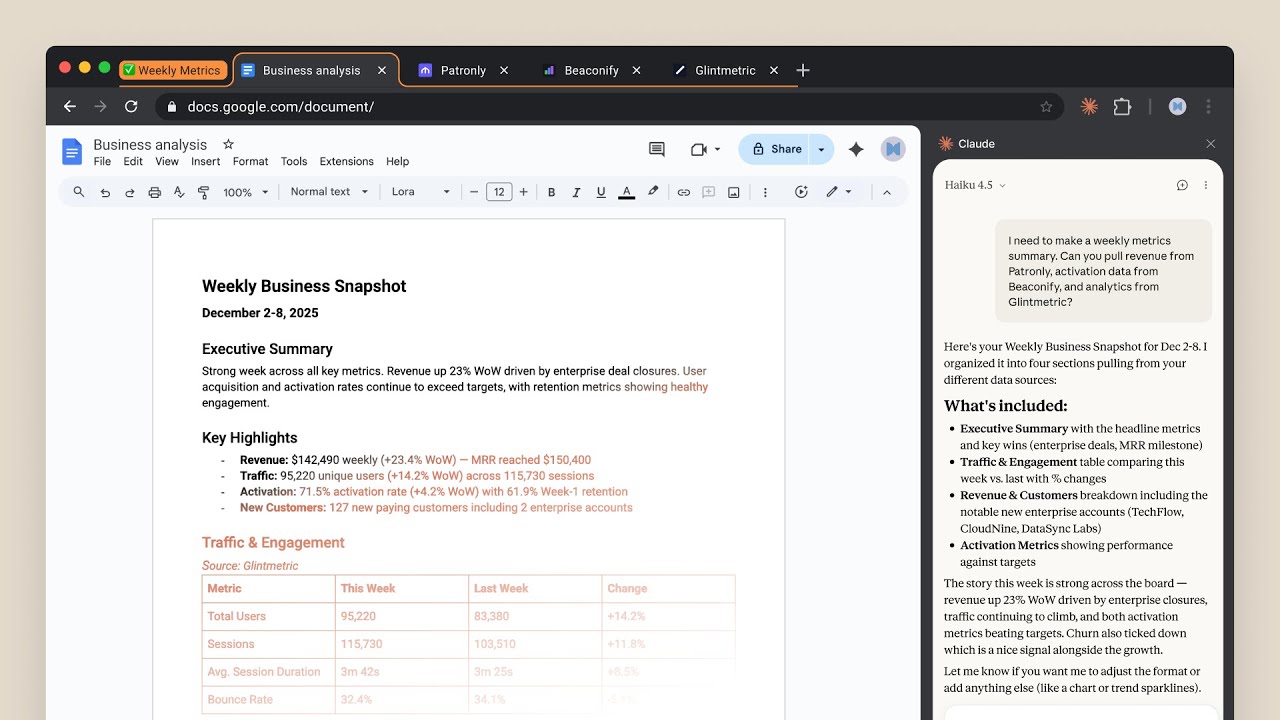
There are a lot of tasks you can assign to Claude in Chrome. I had it set up a meeting by giving a brief description of when, where, and with whom I wanted to meet. The AI scanned my Google Calendar and proposed open time slots within a draft email to my guests.
I also took a page from Anthropic's demos to see how well the AI did at organizing my incredibly scattered Google Drive. After giving it access to the platform, I asked it to go through and put the hundreds of documents and spreadsheets into some order, arranging them in folders with related documents. The AI did exactly that, setting aside any it wasn't sure of for me to assign appropriately. I went from close to 900 loose documents and spreadsheets to six top folders with several subfolders, and nearly 50 duplicates were tidied away.
Workflow training
Arguably, the most intriguing and powerful feature offered by Claude in Chrome is recording a workflow to teach the AI how to do something on your behalf. You click the record button, go about your business as usual, and Claude watches and remembers. The tabs and menus you open, the forms you fill out, and the ultimate goals are all absorbed and become a repeatable pattern that Claude. When you stop recording, Claude doesn’t just memorize clicks; it understands the sequence as a task it can repeat when asked.
I recorded myself running a series of checks across various reward programs I belong to and logging the results in a spreadsheet. When I asked Claude in Chrome to "run the reward points check workflow," it followed my instructions. Claude handled it quite well, with only a couple of errors in passwords slowing it down. The AI even offered to make it a monthly routine that I won't even have to check up on.
And despite the many tabs required for the project, Claude kept them all in its little workspace, running everything in parallel without my having to supervise even the password submissions.
Claude knows all
That undefined boundary between assistance and oversight is where I started to feel like I might have shared too much with the AI. Automating interactions, especially those involving passwords, means exposing personal data to Claude. Every new permission widens the door for Claude to walk through. And since I'm not watching the whole time, I might not even know I've been logged into an account.
There's nothing sneaky about it. When you start an automation workflow, Claude asks for permissions. That said, the way it stitches itself into your web experience leaves you wondering how much of your digital life you’ve opened up to Claude's inspection.
That's the kind of capability that makes Claude in Chrome stand out as more useful than lighter AI extensions limited to visible text. Comparing Claude in Chrome with other AI browser extensions makes that distinction clearer. Tools attached to models like ChatGPT often limit themselves to helping reshape text or summarize selected articles. Claude is designed to infer context and act upon it. On the other hand, Claude's deep dives mean it's acting as your representative, and you're not even nearby.
I might have tried Claude in Chrome even if it weren't for an article, but it did bring home to me that as "AI agents" become more ubiquitous and more powerful, the question of trusting AI with your data will matter for how it is deployed on the internet in real time as much as how it is absorbed by the models powering AI assistants. Anthropic acknowledges this and even notes that people shouldn't use the automated version of Claude for tasks like banking. Still, with the right privacy protections in place, I can see using Claude to handle all the tedious chores I have online, though I'll still want to check up on it every so often.
Follow TechRadar on Google News and add us as a preferred source to get our expert news, reviews, and opinion in your feeds. Make sure to click the Follow button!
And of course you can also follow TechRadar on TikTok for news, reviews, unboxings in video form, and get regular updates from us on WhatsApp too.

➡️ Read our full guide to the best business laptops
1. Best overall:
Dell Precision 5690
2. Best on a budget:
Acer Aspire 5
3. Best MacBook:
Apple MacBook Pro 14-inch (M4)

You must confirm your public display name before commenting
Please logout and then login again, you will then be prompted to enter your display name.