
Crossplay is busy rising through the Apple App Store charts, currently sitting at the Number 1 position among Casual gaming apps. In my house, it's already a bit of a competitive obsession between family members. It's also worth noting that this game is unlike anything The New York Times created before. Instead of sharing your results on social for some recognition and cred, you're reveling in one-to-one competition, and then coming back for more.
But where did this app come from, and why did The New York Times make it? Here's the full, inside story.

Like Scrabble, the free-to-download Crossplay starts as an empty, in this case, 15x15 grid with only bonus squares visible. Each player starts with seven letter tiles (each letter has a numerical value) that they can use to build words on the board and collect point totals. Similar to Scrabble, you can use letters in a word to build new words, and building on top of bonus squares increases your word scores. Opponents (from your Friends list, people whose abilities you might match, or the computer) take turns and gather points until they've run through all their tiles. There are more details, like the ability to swap tiles and skip turns, but that's the thrust of it. It's fun and, yes, a bit addictive.
To understand Crossplay's origins, development, quirks, and future, I spoke to New York Times Senior Producer Jeff Petriello, a talented guy I coincidentally worked with at Mashable more than a decade ago.
"I'm the producer of, specifically, our new games," Petriello told me, adding that he's responsible for Connections, Strands, Pips, and the new Crossplay. He also revealed that something called "Capture" is currently in beta.
The making of a game

While Petriello isn't coding the games, his responsibilities run far and deep. "My job is to ship the game," he explained, which, in his telling, sounds a bit like herding cats. Petriello keeps an eye on the feature backlog and ensures that the features align with the engineering capabilities. He also works with the product designers.
"I've heard a definition of game producers as designers of alignment, and I really resonate with that," he said.
Crossplay, though, was different. First of all, unlike say Wordle or Strands, it's a standalone app. Wordle and Connections are built basically as Web apps that can be played online or within the container of The New York Times Games app.
Crossplay, on the other hand, "is the first standalone app that The New York Times games team has made outside of The New York Times games app. From a scale perspective, it's way larger than releasing a new puzzle that shows up in the games app," said Petriello.
On the iPhone, where I played, Crossplay is a native iOS app built on Swift, but it's also on Android.
"We had to do a lot of technological work that was sort of unprecedented for us as a team, which was really challenging and exciting," he added.
Sometimes, an app is where it's at
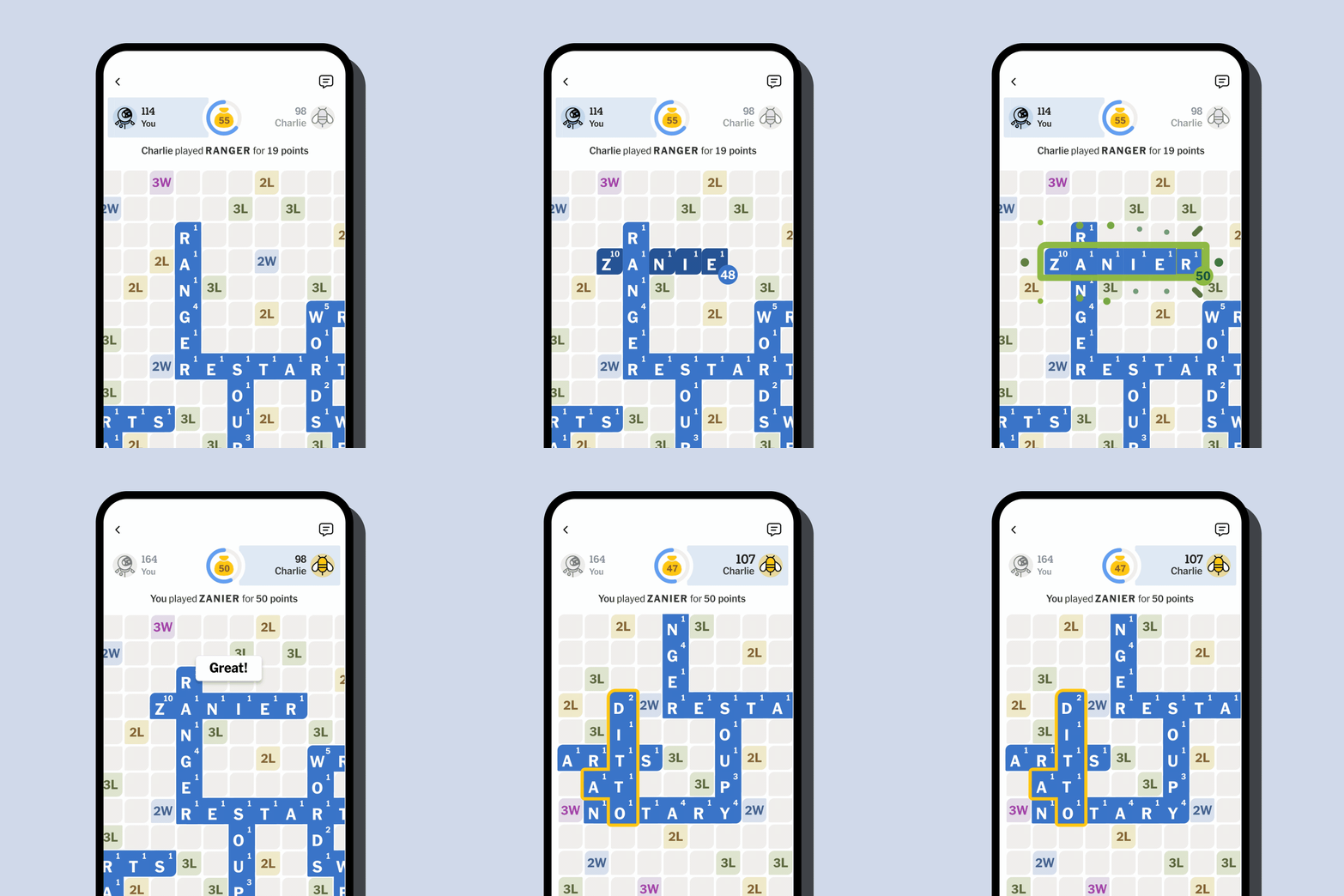
Why did The New York Times choose to build Crossplay as an app? Petriello told me that a 2-player game (there are no plans to add more players at the moment) is, technologically speaking, far more complex than a single-player web-based game. "It has a social graph that needs to be plugged into it," said Petrielo. Plus, Crossplay has a chat feature, "which we don't have at all on the games app."
Crossplay does, though, also live within The New York Times Games App container.
I asked Petriello about the resemblance to Scrabble, and while he didn't directly reference Hasbro's iconic game, he told me, "Crossplay is definitely building on the tradition of classic 2-player word games." He also, though, sees clear differences.
"It is unique in its layout in the way that we distribute the tiles. The bonus squares, for instance, on the game board are distinct, and they were optimized for this sort of digital social play."
Petriello said the asynchronous play is also a differentiator. "You're always playing with 2 players, never more. We really thought about the...environment that you're playing in and tried to optimize."
It is early days for Crossplay, and Petriello expects to learn a lot from the early adopters like me. I told him that when I tried to play against another human player, I kept running into the same opponent, "Kae," who had already maxed out the number of games they could play at once.

"This game is just at the start of its journey, and I hope it grows with our audience, and we can change it in exciting ways in the future," he said.
It's not that the game isn't relatively feature-rich. Petriello revealed a few non-obvious features, like the ability to long-press a word on the board and get a dictionary pop-up, the subscriber-only Crossbot that can give you post-game analysis, and how you can choose different difficulty levels when playing against the computer.
"I always recommend if you're stacked up waiting for folks, play a computer game while you wait... you can get those to be pretty difficult, although we're already seeing feedback from people that the difficult one isn't difficult enough," he told me with a laugh.
As usual, even now, there are already Crossplay experts yearning for more.
One thing that Crossplay doesn't have is the ability to instantly share your results, though, obviously, if you're playing against someone, they already know.
"We kind of want to see how users are looking at sharing their experiences on Crossplay. Definitely an area that I'm like, super interested in seeing," said Petriello, who reminded me that Wordle's share "was a thing invented by the community."
Follow TechRadar on Google News and add us as a preferred source to get our expert news, reviews, and opinion in your feeds. Make sure to click the Follow button!
And of course, you can also follow TechRadar on YouTube and TikTok for news, reviews, unboxings in video form, and get regular updates from us on WhatsApp too.

You must confirm your public display name before commenting
Please logout and then login again, you will then be prompted to enter your display name.