
One of the best soundbars is essential if you’ve invested in a big TV and its speakers aren’t living up to its visuals. With one of the top soundbars, you get bigger, forward-facing speakers that deliver better speech clarity and immersion in movies. The best bit is they’re sleek and slim, often fitting below your TV on a cabinet, or mounted on the wall.
Some TVs may not need a soundbar, but plenty of the best TVs you can buy today benefit hugely from an external soundbar for better audio – especially cheaper ones. The best soundbars tend to come in three styles: all-in-one units with just a single soundbar, soundbars with subwoofers, and soundbars with subwoofers and rear speakers for surround sound. The first is ideal for people who want a minimal setup, the second is great for big sound on a budget, and the third is perfect if you want a real home theater audio experience.
Some soundbars include extra features when used with a particular TV, so we'll highlight those where appropriate, and we do test them – but they don't make or break our recommendations. We test soundbars as if you're buying them as a neutral, so you can get a great upgrade no matter what TV brand you have.

Matt is TechRadar's Managing Editor for Entertainment, and has over 15 years of experience in tech publishing. He has been writing about the latest soundbars and TV audio since 2017, and has very strong opinions about the correct ratio of HDMI ports to price.
January 12, 2026
Replaced the Samsung HW-Q800D with its successor the Samsung HW-Q800F as 'best overall.' Replaced the Amazon Fire TV soundbar with the Sony HT-SF150 as 'best super-cheap' option as former is no longer on sale. Replaced the JBL Bar 1300X with the new JBL Bar 1300MK2 as 'best for flexibility.'
The best soundbars you can buy
Why you can trust TechRadar We spend hours testing every product or service we review, so you can be sure you're buying the best. Find out more about how we test.
The best soundbar overall


✅ You want the best-value soundbar: The Q800F's performance and feature set is superb for its price. You won't get a better value soundbar than this.
✅ You want a powerful sound: The Q800F delivers punchy, engaging sound, with strong bass and expansive Dolby Atmos reproduction.
❌ You want 4K 120Hz passthrough: If you have a next-gen console such as a PS5, you'll have to look at other soundbars for 4K 120Hz passthrough.
❌ You want the best-looking soundbar: The Q800F's design is safe, if not a little bland. If you want a more stylish soundbar, look elsewhere.
What you need to know: The Samsung HW-Q800F is the mid-range model in Samsung's 2025 soundbar lineup. It has a 5.1.2-channel speaker configuration and delivers 400W total power. Its sound is powerful, expansive and detailed, with impressive Dolby Atmos reproduction. It supports both Dolby Atmos and DTS:X audio formats, as well as Wi-Fi and Bluetooth for music streaming. It also supports Samsung's Q-Symphony, which enhances the overall sound when connected to a compatible Samsung TV. There are gaming features included, but no 4K 120Hz passthrough support. This, however, is the only real negative on what is an otherwise fantastic soundbar.
Audio performance: When we tested the Q800F, we were seriously impressed by its detail, dialogue clarity and accuracy, with precise positioning of sound effects. This was surprising considering it is just a soundbar and sub combo. The re-designed subwoofer may be smaller but it still delivers a mighty punch with plenty of room-filling power. We were also impressed by the Q800F's Dolby Atmos reproduction, which felt expansive and immersive, again without rear speakers. Across the board, the Q800F delivers superb sound quality.
Design: While the Q800F is solidly built, it isn't the most stylish system. The subwoofer is more compact and sleek than its predecessor's sub, but crucially still delivers great performance.
Value: The Q800F is superb value. While it may not deliver the full-blown surround sound experience of the Samsung HW-Q990F (#4 on the list) or have the looks of the Sonos Arc Ultra (#11 on the list), it's a phenomenal soundbar for the money. No other soundbars at this price range can compete.
Read our full Samsung HW-Q800F review
The best budget soundbar
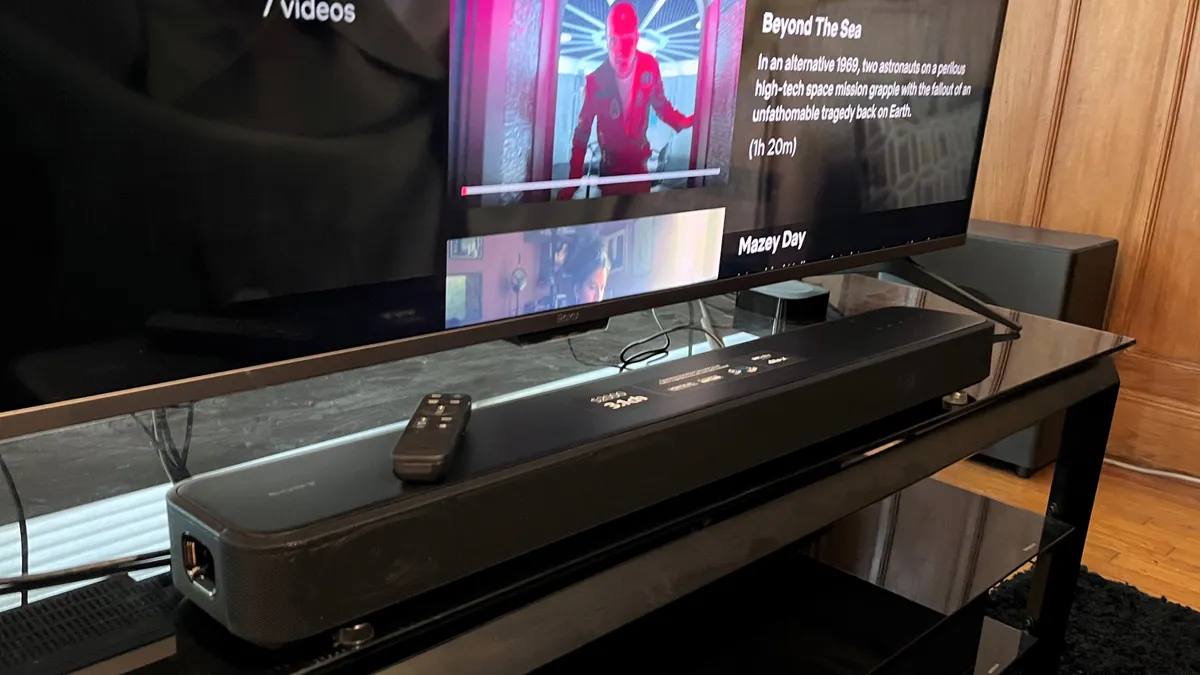


✅ You want an affordable soundbar: The Sony HT-S2000 launched with a higher price than the next cheapest offering at #7 in this list but is now regularly reduced for less.
✅ You want immersive sound: The HT-S2000 offers 3.1 channels of surprisingly powerful sound, with support for virtual Dolby Atmos, for a reasonable price.
❌ You own a next-gen console like a PS5: Without 4K 120Hz passthrough, the HT-S2000 isn't the best for gamers. Instead look at #5 in this list.
❌ You want a home audio system: The HT-S2000 does not have Wi-Fi so you won't be able to link it up to a multi-room wireless speaker system.
What you need to know: When it comes to sound quality and features vs price, we think the Sony HT-S2000 is the best budget choice around. Although it's a little basic in terms of connectivity, the sound you get from this soundbar is impressive for the money and is certainly a good choice for those looking for an upgrade to their TV sound without breaking the bank.
Audio performance: While the Sony HT-S2000's sound isn't the biggest, the sound you do get for your money is impressive. Clear dialogue levels and a spacious, virtual surround sound are two of the HT-S2000's highlights. Bass levels are also punchy enough, but it's the Sony HT-S2000's ability to reproduce Dolby Atmos effects that's surprising. It's not going to beat a soundbar with height channels, but for a 3.1 soundbar, it offers plenty.
Design: Design wise, the Sony HT-S2000 feels and looks more expensive than it is, with a solid, mesh metal grill on the front and a sturdy black plastic casing housing the speakers. The soundbar also produces visual feedback to remote control commands, something rare on budget soundbars.
Value: Yes, the HT-S2000 isn't going to set the world alight with its sound and certainly isn't the best soundbar for sound on this list, but when you're paying roughly $349 / £299 / AU$695 for a soundbar with this good a sound quality, it's hard to argue against.
Read our full Sony HT-S2000 review
The best all-in-one soundbar


✅ You want uncompromised home theater sound: The Flexus Core 300 gives you a real Dolby Atmos home theater experience from a standalone soundbar, with height effects and enough bass that you can feel it.
✅ You want great sound in any room: This soundbar’s Dirac Live room correction processing provides clear and balanced sound even in a less-than-ideal room.
❌ You have a small room: This is a large soundbar, and it’s best suited to systems with a 65-inch or larger TV in a sizeable room. If your setup is more compact, there are plenty of other soundbars that will be a better fit.
❌ You don’t use Google Home: If you’re an Alexa or Apple HomeKit user, the Flexus Core 300’s exclusive support for Google Home means you won’t be able to link it with your smart home ecosystem.
What you need to know: The Klipsch Flexus Core 300 is a fantastic option for an all-in-one 5.1.2-channel soundbar, and it’s also one that lets you expand to a full 7.1.4-channel system by adding Klipsch’s optional wireless surround speakers and subwoofers. With both HDMI eARC and HDMI 2.1 ports, the latter with 4K 120Hz passthrough, the Flexus Core 300 is ready to connect to the latest TVs and games consoles, and its Wi-Fi support means you can stream uncompressed music via Tidal Connect and Spotify Connect, or directly from apps using AirPlay or Google Cast. But the key feature of Klipsch’s flagship Dolby Atmos soundbar is Dirac Live room correction, which can make the Flexus Core 300 sound great in any room it’s set up in.
Audio performance: The Flexus Core 300’s basic sound quality is very good, with natural dialogue and enough bass to deliver oomph and physicality in action movie soundtracks. But once you’ve run the Dirac Live calibration, something that’s done from within Klipsch’s control app and uses an included microphone, sound quality notably improves, with cleaned-up bass and enhanced mid-range clarity, especially with voices. In our review, we stated, “No matter how complex the soundtrack or music was, I could hear everything with precision.” Such high praise isn’t something that normally gets applied to a soundbar.
Design: At 54 x 3 x 5 inches (1371 x 76.2 x 127mm), this is a big soundbar, and one best paired with 65-inch or larger TVs. Available in black or walnut, both with an elegant woodgrain finish, the Flexus Core 300 features a bright alphanumeric LED display with a large readout so you can get visual feedback from remote control commands even at a far seating distance. An included remote has a solid feel and enough buttons to let you control most functions, and there are optical digital input and RCA subwoofer outputs on the back, along with the soundbar’s HDMI ports.
Value: At $1,199.99 / £1,049.00, the Flexus Core 300 is pricey for a standalone Dolby Atmos soundbar, but its performance and feature set, which includes the option to expand out to a 7.1.4-channel system by adding wireless surround speakers and subwoofers, go a long way toward justifying that cost. Klipsch’s flagship is also the only soundbar with built-in Dirac Live room correction, making it a one-of-a-kind product.
Read our full Klipsch Flexus Core 300 review
The best soundbar for Dolby Atmos


✅ You want immersive surround sound: The Q990F delivers a fully immersive, powerful, and tightly controlled sound that not many other soundbar systems can compete with.
✅ You want a compact subwoofer that doesn't compromise: The Q990F's newly designed compact subwoofer is easier to hide, but doesn't skimp on sheer power and control.
❌ You're on a budget: The Q990F is a premium soundbar system that unavoidably costs more than budget Dolby Atmos soundbars like #4 in this list.
❌ You own the Samsung HW-Q990D: While the Q990F's new subwoofer is great, elsewhere the Q990F is only a slight upgrade over its predecessor, the Q990D.
What you need to know: Samsung’s Q990F is a complete surround sound system in a soundbar package. It has 23 drivers spread across 11.1.4 channels and comprises four units: a soundbar, a subwoofer, and two rear speakers. It delivers engaging, expansive and punchy sound, as well as 4K 120Hz pass-through support for gaming consoles.
Audio performance: Dolby Atmos soundtracks are reproduced with superb precision and pinpoint accuracy, putting you right into the heart of the action. Speech is clean and clear, and its newly designed, smaller subwoofer doesn't skip out on bass, delivering plenty of hefty rumble while still maintaining control and nuance. Q-Symphony is a bonus for Samsung TV owners, adding even more speakers to the action.
Design: The headline here is the newly designed, compact subwoofer, which is sleeker, sharper and much more versatile in terms of space. The Q990F has a similar matte gray/navy finish to its predecessors for a minimalist look, but uses a grille design that isn't as appealing as its predecessors. Still, it has a premium look and feel with a reassuring heft. Its front display continues to be difficult to read, however
Value: A soundbar system that's this powerful and complete necessarily comes with a high price tag. And while we think that the Q990F's performance justifies the price, you can save some money by picking up its predecessor, the Q990D. Or if you're looking for a budget alternative, check out the Hisense AX5125H at #5 in this list for a cheaper Atmos alternative.
Read our full Samsung HW-Q990F review
The best budget soundbar for Dolby Atmos surround


✅ You want 'real' Atmos sound
With 5.1.2 channels, including two surround and two up-firing Atmos speakers, you're getting actual immersive sound rather than virtual processing.
✅ You want to save money
At around $350 / £350 / AU$449, you’re getting a full surround sound speaker package with a subwoofer for the price of many standalone soundbars.
❌ You want high-quality music playback
Hisense’s budget bar uses Bluetooth exclusively for music streaming, and that’s a lower-quality option than the Wi-Fi tech used by other soundbars like the Sonos Beam.
❌ You want to experiment with EQ
While the Hisense has preset sound modes plus bass and treble controls, its sound adjustments are very basic compared to other soundbars that offer extensive EQ settings and room correction using apps.
What you need to know: The Hisense AX5125H is a 5.1.2-channel Dolby Atmos soundbar system with a wireless subwoofer and surround speakers that sells for under $350 / £350 / AU$450. What you’re getting here kit-wise for the money is pretty much unbeatable considering the system’s punchy sound and “real” as opposed to virtual, Dolby Atmos effects delivery.
Audio performance: Hisense’s budget soundbar system punches well above its price class when it comes to sound quality, with clear dialogue, accurate effects placement and good surround immersion. Even music sounds good, though, streaming is limited to Bluetooth quality. The one complaint we have about its sound is that the compact rear speakers can occasionally get overwhelmed by aggressive surround sound mixes.
Design: The AX5125H’s build quality falls short of premium – something to be expected at this price – though its metal mesh speaker grilles give it a somewhat upscale look. Importantly, the soundbar has a front panel alphanumeric LED display, which provides clear visual feedback when making volume or EQ adjustments with the system’s remote control.
Value: Given its low price for a 5.1.2-channel soundbar system, the Hisense AX5125H’s value is almost over the top. You’ll pay more than four times as much for the Best soundbar for Dolby Atmos choice on our list, the Samsung HW-Q990D, and while that 11.1.4-channel system will undoubtedly provide a greater sense of sound immersion, many people will be satisfied with the Hisense’s sound for the money.
Read our full Hisense AX5125H review
The best super-cheap soundbar for surround sound


✅ You want surround sound for cheap: The Poseidon D50 offers 5.1 channels of clear, punchy sound for cheaper than most soundbars.
✅ You want a straightforward soundbar: The Poseidon D50 opts for a no-nonsense, plug-in-and-play approach over apps and features.
❌ You want the best quality sound: The Poseidon D50's sound can be tinny at times, and rear speakers can get lost in the mix.
❌ You want the best looking soundbar: Unsurprisingly, the Poseidon D50 has a plain, plasticky look due to its super-cheap price.
The Ultimea Poseidon D50 is the best way to get surround sound for your living room for a low price. Its sound may not be the most dynamic and it's light on features, but at such a low price for a full 5.1 system, it's hard to argue against what it does deliver: clear, punchy and occasionally spacious audio.
In our review of the Ultimea Poseidon D50, we enjoyed its clarity of speech and relatively punchy, powerful surround sound. While watching Top Gun: Maverick, we were "impressed at the three-dimensional sound of soaring aircraft", especially considering the lack of Dolby Atmos. While the Poseidon D50 doesn't deliver the most cinematic of experiences, with audio sometimes veering on tinny and the rear speakers sometimes struggling to keep up, we said "for the price you pay, the surround sound certainly surpassed expectations" and that's all we ask for from this cheap soundbar.
Light on features due to its budget price, including a lack of Dolby Atmos and DTS:X support (check out the Hisense AX5125H further up the list for a budget Atmos surround soundbar), the Poseidon D50 does still support Bluetooth streaming for music and come with HDMI ARC, optical and 3.5mm ports for connections. There are also three distinct sound modes – Movie, Dialog and Music – to cater to what you're watching.
Ultimately, you get what you pay for, and the Ultimea Poseidon D50 delivers solid (but not mind-blowing) surround sound for under $150 / £150 (we've seen it as low as $119 / £139). At that price, it's difficult to be disappointed in the Poseidon D50. If you want surround sound for cheap, the Poseidon D50 should be on your list.
Read our full Ultimea Poseidon D50 review
The best super-cheap soundbar


✅ You want a cheap, but good soundbar: You can pick up the HT-SF150 for $129 / £99 / AU$194, a cheap price for a soundbar like this.
✅ You don't want to compromise on looks: Cheap soundbars can look cheap, but the SF150 has solid build quality and aesthetics that make it feel more premium.
❌ You want Dolby Atmos support: Dolby Atmos isn't supported on the HT-SF150. If you're looking for a cheaper soundbar that does support Atmos, the Sony HT-S2000 on this list is a great choice.
❌ You want a soundbar for music: While the HT-SF150's music performance is passable, it can't compete with more premium soundbars.
What you need to know: The Sony HT-SF150 is an affordable 2.0-channel soundbar. While it doesn't support Dolby Atmos or DTS:X, it delivers solid sound quality and feels solidly built. It supports Bluetooth for music streaming and plug-and-play setup. While it doesn't deliver the strongest sonic experience, it is very good for its very cheap price and will make a fine upgrade over a lot of TV speakers.
Audio performance: The HT-SF150 delivers solid, built-in sound with clear speech and surprisingly effective virtual surround sound processing. Bass is decent and while it isn't room-shaking, it's commendable for a standalone soundbar. We found during busier scenes in movies or video games that sound can get 'bloated', with 'a lot of business in the mid-range'. With no Dolby Atmos or DTS:X support, you won't get the full cinematic experience, but for the price, the HT-SF150 more than delivers.
Design: The HT-SF150 is one of the better-looking cheap soundbars on the market. It has an attractive leather-like top, wraparound speaker grille and onboard buttons. Its supplied remote is also sleek for this price range. Its LED display can be unclear sometimes, but that's really the only complaint we have with the HT-SF150's design. Apart from that, it's a real looker.
Value: Considering the sound it delivers, its ease of use and its attractive design, the HT-SF150 is a steal at $129 / £99 / AU$194 (it's been cheaper before too!). You're not going to find many standalone soundbars of this quality at this price.
Read our full Sony HT-SF150 soundbar review
The best premium soundbar for LG TVs


✅ You want immersive, home theater sound: With 9.1.5 channels here along with AI room calibration, you're in for a surround sound treat.
✅ You have an LG TV: It works well whatever you pair it with, but you get access to better features with certain models of LG TVs.
❌ You don't have much space: This soundbar system is large, so if you don't have room to spare opt for a smaller alternative like #5 in this list.
❌ You're saving money: This isn't a budget buy. You'll have to make sacrifices, but you can find a similar soundbar for less. Check out #2 in this list.
What you need to know: The LG S95TR brings you the convenience and straightforward setup of a soundbar system but with the immersive power and performance of a home theater speaker setup. It works well with everything, but LG TV owners can unlock the best features. The only thing that lets it down a little is its high price. If you're on a budget but still want Atmos and surround sound, take a look at our cheap soundbar pick, the Hisense AX5125H at #4 in this list. But if you can afford it, the features, performance and design of the LG S95TR make it worth every penny.
Audio performance: With this soundbar's 9.1.5 channels, along with some very impressive AI room calibration, you'll experience a great home theater setup with surround sound and spatial audio (Dolby Atmos and DTS:X). In our review, we described the sound on offer here as "immersive, engrossing, and engaging" and with 810 watts of power, the LG S95TR can reach great volumes.
Design: This soundbar looks very basic with a subwoofer and two wedge-shaped rear speakers. Unfortunately, there's no LED display, just LED indicator lights, which is disappointing considering how many features are on offer here. You'll need to open LG's control app to find what you need, which is a little annoying. This is also a big system. So if you want to put it in a small room, it might not be the best choice for you.
Value: The LG S95TR’s $1,499 / AU$1,699 (about £1,200) price feels expensive, but when you compare it with the competition, the fact you're getting a 9.1.5-channel system and the performance on offer here, it's still good value. If you want real surround sound, check out #3 in this list, the Samsung HW-Q990D.
Read our full LG S95TR review
The best compact Atmos soundbar


✅ You want great sound from a standalone soundbar: The Smart Soundbar delivers the Bose audio quality one expects. The bass and soundstage width are a bit light, but clarity and dynamics are good.
✅ You want real Dolby Atmos: The soundbar’s two upward-firing speakers let it deliver a real spatial audio experience. Also, a TrueSpace feature can upscale non-Dolby Atmos tracks for spatial audio.
❌ You want full surround sound: Adding Bose Ultra Open Earbuds can give a great surround sound experience, but just for one person. If you want full surround sound for around the same price, other options are available.
❌ You’re on a tight budget: The Smart Soundbar has a premium price for a single soundbar. You can find similar compact soundbars for less, but you will compromise on both sound quality and features.
What you need to know: The Bose Smart Soundbar is a compact model with real upfiring speakers to properly deliver Dolby Atmos soundtracks. It has built-in Wi-Fi for streaming music, AirPlay 2 and Chromecast support, and can be paired with optional Bose wireless surround sound speakers and a subwoofer if you one day get an urge to upgrade your system. Alternatively, the Smart Soundbar’s Personal Surround Sound feature, which requires Bose’s Ultra Open Earbuds, can give you surround sound without having to muck with extra speakers.
Audio performance: When we reviewed the Bost Smart Soundbar, we noted that it “sounds about as good as a soundbar can.” Dialogue is “consistently intelligible,” and there are level and EQ controls in Bose’s app that let you boost it on an as-needed basis. Because of its compact form factor, both bass and soundstage width are limited, but the Smart Soundbar’s upfiring Atmos speakers, which can also be engaged for non-Atmos movies and music using the TrueSpace feature, help quite a bit to expand the soundfield.
Design: At 27 inches wide by 2 inches high and 4 inches deep, it’s a fairly sleek and compact design for an all-in-one unit and a perfect choice for smaller homes or screens. While it only has a single HDMI port, it makes up for this by packaging everything into an attractive all-in-one form.
Value: This soundbar impressed us in several ways during our testing, and we also appreciated its Personal Surround Sound and TrueSpace features The Bose is also a good value – as one of the few soundbars that sell for under $500 / £500 / AU$700, it offers a lot more features than the Sony HT-S2000 at #2 in this list.
To save money on Bose products, check out our Bose discount codes.
Read our full Bose Smart Soundbar review
The best soundbar for flexibility


✅ You want awesome Dolby Atmos: The JBL Bar 1300MK2 has some of the best Dolby Atmos performance on the market.
✅ You want rear speakers with no wires: Supplied with wireless rechargeable speakers, so there are no power cords to plug in.
❌ You're a gamer: The 1300MK2 may have four HDMI ports, but none of them support 4K 120Hz or ALLM. Look to the Samsung HW-Q990F for these features.
❌ You want a cheap soundbar system: The JBL Bar 1300MK2 is a premium soundbar and as such, carries a premium price tag.
What you need to know: The JBL Bar 1300MK2 is an 11.1.4-channel soundbar system, totaling 2470W of power. What makes this soundbar so flexible is its four HDMI ports and its detachable rear speakers that can be attached to the main soundbar for recharging when not in use. The 1300MK2 is an impressive sound system that supports Dolby Atmos and DTS:X format, as well as Wi-Fi and Bluetooth streaming for music. The downside? None of its four HDMI ports support 4K 120Hz, so gamers might want to look elsewhere if this is a dealbreaker. For movies, though, it's a powerhouse.
Audio performance: The 1300MK2 delivers spectacular sound, with room-shaking bass from its subwoofer, crystal clear dialogue and excellent immersion with Dolby Atmos soundtracks. It even sounds great for music, with both stereo and Atmos mixes impressing us during testing. Its 29 drivers really do work together to deliver an outstanding, seamless audio experience.
Design: While the 1300MK2 does have detachable speakers for convenient space saving, the soundbar itself is quite wide. The subwoofer, which does look much sleeker, is also a meaty bit of kit. Its build quality is superb and it feels every bit as premium as you'd hope at this price. Looks-wise, it's on par with its rivals.
Value: The JBL Bar 1300MK2 carries a premium price to match its performance. In its defence, its $1,699.95 / £1,299.99 / AU$2,299.95 price is competitive with the likes of competition such as the Samsung HW-Q990F.
Read our full JBL Bar 1300MK2 review
The best soundbar for expandability


✅ You want big and cinematic sound: The Arc Ultra's special bass driver sounds excellent, and its sound balance is excellent, especially the dialogue.
✅ You want an expandable soundbar: You get great Dolby Atmos effects from a single box here , and it can be easily expanded with Sonos surround speakers and subs.
❌ You want high-end DTS:X support: Fans of Blu-rays or streaming IMAX Enhanced movies may be annoyed by this – you won't get the full power.
❌ You struggle to have enough HDMI ports on your TV: There's no HDMI passthrough here, so you simply lose the use of whichever port it's connected to.
What you need to know: The Sonos Arc Ultra is the best soundbar for expandability. It sounds great on its own, but the flexible nature of the Sonos ecosystem lets you easily add surround speakers and a subwoofer as your needs and budget change. Other soundbars here deliver more immersion by filling your room with multiple boxes, but if you want deep, expansive, expertly balanced movie audio from one slender bar, with the option to add to it later, this is the way to go.
Audio performance: The Sonos Arc Ultra is a very impressive piece of audio design, thanks partly to its 'Sound Motion' bass driver, which is a very small speaker that produces decent bass without a separate subwoofer. It helps the overall sound balance of the Arc Ultra to be absolutely superb, with great impact, very clear yet natural dialogue, and effects that jump right out of the mix. The Dolby Atmos 3D sound is excellent for a single-box soundbar as well, really adding motion and layers to individual sounds. A massive upgrade over any TV's built-in sound.
Design: This is small for a powerful one-box soundbar – but that's relative! It's pretty wide, though will work for TVs of 55 inches and up, but it's not too tall or deep (though may be too tall for some very low-slung TVs). It feels really well made, and the simple, hard-shell black or white design disappears nicely into your decor. The connections are in a recess in the back – as is the Bluetooth pairing button, annoyingly (but you can use the Sonos app to pair too). It's wall-mountable, too.
Value: This is strong value, simply because it sounds so good for under $1000 / £1000. It's also great that it works as part of the Sonos ecosystem, and can be expanded with Sonos' wireless speakers as rear speakers, or with a dedicated, more powerful subwoofer. However, its lack of DTS-HD/DTS:X support and not having an HDMI passthrough port when all of its key rivals do mean it's less-than-perfect on value – but if you don't care about those things, then they're not a problem!
Read our full Sonos Arc Ultra review
The best soundbar for wall-mounting


✅ You want a versatile design: It’s our top choice for wall-mounting, but it’s just as happy on a tabletop. If you want flexibility for both, you’ll find it here.
✅ You want more powerful sound than a standard TV can muster: You’d be forgiven for thinking the low profile of this soundbar means it doesn’t pack a punch, but no built-in TV sound is anywhere near this good.
❌ You’d prefer a full surround sound experience: You’ll get a pleasingly large soundstage here, but with no rear speakers, it won’t wrap sound around you like the best systems can.
❌ Wall-mounting is only a “nice to have”: Pretty sure you won’t wall-mount it? Look elsewhere. It’s still a great choice, but if it’ll always sit on your TV table, its versatility won’t matter.
What you need to know: The Samsung HW-QS700F soundbar blends the performance of Samsung’s Q series with the sleek, lifestyle-friendly design of its S series. Its standout feature is the ability to automatically optimize its 3.1.2-channel speaker setup depending on whether it’s mounted horizontally or vertically. In vertical mode, its flatter profile pairs neatly with a slim, wall-mounted TV. Sound quality is solid for the price, with support for Dolby Atmos, DTS and Bluetooth. It comes with a Samsung wireless subwoofer and can also be paired with surround speakers – but it’s the wall-mounting versatility that really sets this model apart.
Audio Performance: Despite its affordable price, this soundbar’s 3.1.2-channel configuration delivers an impressive level of power, detail, and staging. Most of that top-performing sound holds up regardless of its orientation, though there are some minor niggles depending on how you use it. Then again, as we noted in our review, it still outperforms the vast majority of rivals. You’ll also get to enjoy Dolby Atmos playback, DTS:X support and compatibility with a broad range of file formats.
Design: The design is where the HW-QS700F truly shines. It features gyro sensors that automatically adjust the speaker configuration for optimal performance whether it’s placed on a table or wall-mounted. The long, angular bar and its compact, cubic wireless sub are surprisingly space-efficient for such a powerful system. It’s slender enough to slide beneath most TV screens or can easily be mounted on the wall underneath one, yet long and deep enough to promise potent sound and a premium finish.
Value: Considering its blend of performance and features, the Samsung HW-QS700F is a compelling choice. While many soundbars can either be wall-mounted or tabletop-set, few adjust their speaker configuration to optimize performance for both setups. It’s a great option in its own right, but it’s our top pick for wall-mounting – ideal if you want to take full advantage of that versatility or simply love the option to move it around.
Read our full Samsung HW-QS700F review
The best soundbar for desktops


✅ You want something that could work for your TV and your desk: Creative comes from the world of PC audio, so naturally this soundbar can switch between your computer and TV.
✅ You want a subwoofer without spending too much: For this price, the soundbar and subwoofer pairing is a bargain. Other brands would charge much more.
❌ You want top tier sound: It's an upgrade over your TV's speakers, but it won't impress more demanding ears. If you're fussy about audio quality you might want a higher-end soundbar option.
❌ You want lots of features: There are nice touches here, but overall it's quite bare bones, with no smart assistant integration or Wi-Fi support.
What you need to know: The Creative Stage Pro is a rare find at this cheap price. It's a compact 2.1 soundbar with a subwoofer that works well under a TV or beneath a monitor. Creative's PC audio roots show here, not just in size and port selection but in near-field listening mode designed for desktop use. It's not packed with features, and its soundstage is narrower than premium bars. But at this price, it delivers a genuine step up from built-in TV speakers and a convincing desktop-friendly alternative to pricier systems. Its SuperWide processing offers a subtle sense of extra space, Bluetooth is onboard for music, and the HDMI ARC, optical, AUX, and USB-C ports give it the flexibility most cheap soundbars lack.
Audio Performance: For the money, the Stage Pro turns in a surprisingly capable performance. Its 2.1-channel setup provides plenty of volume, a healthy dose of bass, and more detail than you'd expect from something this compact. Dialogue is clear, the treble has enough sparkle to keep things crisp, and the subwoofer – while not earth-shaking – adds welcome punch during action scenes and gaming. You won't get deep sub-bass or a wide, cinematic soundstage, and the built-in presets feel too subtle to make a real impact. But Creative's SuperWide mode is useful, with its Near setting pulling the sound closer for a desktop setup, and Far opening things up a bit for TV viewing. It's not Dolby Atmos and it's not pretending to be, but in the budget bracket it holds its own.
Design: Compact, practical and more user-friendly than most budget bars, it's designed to slot into small spaces, especially on a desk. At just under 22 inches wide, it sits neatly beneath a monitor and its slightly angled front helps direct audio toward you. The LED display gives you instant feedback on sources and volume. Physical controls cover the basics, and the remote unlocks adjustments like bass and treble. With HDMI ARC with CEC, optical, AUX, and USB-C, the port selection is also complete for a compact bar. The subwoofer is slim enough to tuck bedside or under a desk, and while its fixed cable isn't ideal, the footprint is very desktop-friendly.
Value: As a budget 2.1 soundbar, the Creative Stage Pro is exceptionally strong value, especially for anyone who wants a subwoofer without jumping to a much higher price bracket. Most alternatives at this price are single-bar setups with noticeably thinner sound. The Stage Pro delivers reliable performance, a proper port selection, near-field tuning and a decent amount of power, all while keeping the price low. It's not feature-rich and it won't satisfy true audio enthusiasts, but as a smart, versatile upgrade for a TV or desktop, it's a solid pick.
Read our full Creative Stage Pro review
Best soundbars: comparison chart
Below, you'll find a chart showing the scores of every soundbar featured on this list, based on the criteria on which we review them: Features, Performance, Design, Setup & usability and Value. You can sort each column by clicking on its header.
How to choose the best soundbar
There are several things to consider when you’re looking for the best soundbar.
The first is the size. You’ll want to make sure that your soundbar fits under—or next to, depending on your set-up—your TV. For example, the long Sonos Arc soundbar is designed specifically for large screens, so won’t look right with a smaller 50-inch TV. You’ll need to know the size of your current TV and the size of the space you have to fit it and compare those figures to the dimensions listed alongside the soundbar you want to buy.
You’ll also want to consider whether you need a Dolby Atmos speaker or not. Dolby Atmos is surround sound technology, placing sounds and voices all around you so that whatever you’re watching or listening to is more immersive. The thing is, Dolby Atmos-enabled soundbars tend to be more expensive. You’ll need to weigh up whether Dolby Atmos sound is worth it for you. Otherwise, consider a capable but cheaper option, like the Sony HT-S2000, our choice for best budget soundbar.
Another thing you’ll want to watch out for is the kind of connection you need. You’ll find most modern soundbars have HDMI connectivity, but there's also optical connectivity—so what's the difference? These are two ways that audio is passed from your TV to your soundbar, but HDMI passes high-resolution audio, including Dolby Atmos.
If you want a premium, immersive listening experience you’ll want to be sure you have an HDMI connection to use from your soundbar and an HDMI ARC (that's audio return channel) or eARC (enhanced audio return channel, a higher-resolution connection) port on your TV for it to connect to.
But this means one of your TV's HDMI ports is used up by the soundbar, so some bars come with HDMI 'passthrough' ports, meaning you can connect a console/set-top box/etc to the soundbar, and it passes the visuals back to your TV. If your TV has few HDMI ports, you'll want a soundbar with this feature.
There’s more to think about, but getting the size, audio features and connectivity nailed down early on should make finding the best soundbar for you much easier.
What connection do I need for a soundbar?
The best way to connect a soundbar to your TV is with an HDMI cable. You'll need to make sure you have an HDMI port on your soundbar and an HDMI ARC or eARC port on your TV. This allows you to use a cable to connect them.
An HDMI port means that the highest quality audio can pass from your TV to your soundbar, like Dolby Atmos.
If your TV or soundbar doesn't have HDMI ports, the second best option is an optical. This can still transfer digital sounds, but not the high-resolution ones you'd get with HDMI.
However, you will still get quality audio and an optical connection does work with soundbars and surround sound systems.
What size soundbar should I get?
You need to get a soundbar that fits in the space you have available. Some people have their TV mounted and a soundbar could happily be mounted underneath. Others have their TV on a stand and the soundbar can sit in front of it.
Consider the space you have free but also the size of your TV. A compact soundbar might look silly with a massive screen and vice versa. There are many different-sized soundbars available to suit your TV, so make sure you check the dimensions and match them up.
Can soundbars do surround sound?
True surround sound means speakers are positioned around you. Some soundbars on this list, like the Samsung Q990D and Hisense AX5125H, also come with a subwoofer and two smaller rear channel speakers, meaning you can place them around your room.
However, other devices with only one soundbar claim to offer surround sound. What this means is they deliver a stereo effect, which seems more like sound is coming from different directions, but isn't.
Many of the high-end soundbars in this list also have Dolby Atmos built-in. Again, this isn't technically surround sound, but the audio tech is advanced and creates the illusion of immersive sound by bouncing sounds off the walls and ceiling around you.
Are Dolby Atmos soundbars really worth it?
Although not all the soundbars on this list capture Dolby Atmos as well as a home theatre system, more and more soundbars are supporting Dolby Atmos, making it available to people with all budgets.
Yes, the level of detail you get from a full home theater system compared to soundbars with 'virtual' Atmos or surround soundbars isn't quite as high, Dolby Atmos soundbars are becoming more sophisticated and provide an extra level of immersion to your cinema experience.
Are soundbars worth it?
Absolutely. Even if you don't consider yourself a hardcore cinephile, the best soundbars make a world of difference to your TV watching experience—even the built-in speakers that come with the best TVs just don't do your favorite films, TV shows, and games justice.
How much should I spend on a soundbar?
It depends on what you're looking for. If you want the very best soundbar technology has to offer, you might be looking at prices of $800 / £800 / AU$1,000 and upwards.
However, there are lots of fantastic budget soundbars on the market, with some costing less than $100 / £100 / AU$150. Just bear in mind that you generally get what you pay for, and these budget models probably won't come with premium features like Dolby Atmos, included rear speakers, and hi-res audio support.
But, the mid-range market is getting more competitive and it really is easy to get a lot of bang for your buck, with soundbars (on our list above) providing Dolby Atmos and a subwoofer for under $400/£400/AU$650 becoming more and more common.
Where should I put a soundbar?
You generally have two options when it comes to soundbar placement: wall-mounting it, or placing in below your TV on your TV cabinet. If your soundbar is quite tall, wall-mounting may be the best option, as it could obscure the IR receiver on your TV, rendering your remote control useless.
Does my soundbar brand need to match my TV?
Quick answer: No, any soundbar can be used with any TV. That’s because all TVs made over the past decade feature HDMI (ARC or eARC) and optical digital connections that output audio signals, and virtually every soundbar will feature both HDMI and optical digital inputs to accept that output. And even if you’re mixing brands, a TV’s HDMI-CEC feature will conveniently let you control the soundbar's volume level using the TV remote control.
Having said that, there are instances where combining soundbar and TV brands will yield benefits. Many Samsung soundbars, such as our best overall pick, the Samsung HW-Q800F, for example, support a feature called Q-Symphony that lets you combine the sound output of the TV’s built-in speakers with the soundbar’s output for an enhanced, more spacious audio presentation. And LG soundbars support a similar feature called Wow Orchestra that automatically integrates the soundbar and TV speakers when connected to a compatible LG TV. In both cases, you will experience more powerful, immersive soundstage than you would from just the soundbar working alone.
Another benefit to using the same-brand soundbars and TVs is the ability to make a lossless wireless audio connection between the two – no HDMI cables required. Once again, this feature is supported by select TVs and soundbars from Samsung, which simply calls it Wireless Dolby Atmos, and LG, which calls its version WowCast.
What is Eclipsa Audio, and does my soundbar need it?
At the CES 2025 trade show, Samsung announced a new immersive audio format meant to compete with Dolby Atmos. Eclipsa Audio was jointly developed by Samsung and Google, and it will be supported by new Samsung TVs and soundbars coming out in 2025. Other TV and soundbar brands didn’t announce any new products with Eclipsa Audio support at CES, but since Google is involved, the format will certainly be supported on future TVs that run the Google TV smart TV platform (Hisense, Sony, TCL, among others).
Eclipsa Audio differs from Dolby Atmos in that it’s a channel-based format. Dolby Atmos soundtracks are “object-based” mixes comprised of audio “objects” positioned in 3D space that are scaled to a specific speaker configuration (e.g., 7.1.4 Atmos, 5.1-channel surround, 2-channel stereo). Eclipsa Audio, in contrast, supports up to 28 input channels, which Samsung and Google say is sufficient to provide an immersive 3D audio experience on systems ranging from headphones to multichannel home theaters.
While its license-free status should make it appealing to hardware manufacturers (Dolby, in contrast, charges licensing fees for Dolby Atmos), a key challenge that Eclipsa Audio faces is streaming services support. Dolby Atmos is firmly entrenched in the streaming ecosystem, while Eclipsa Audio is currently only supported by Google-owned YouTube. Given that situation, it’s safe to say that Eclipsa Audio support on soundbars is a non-issue for now, though it’s something to keep an eye on for the future.
Other soundbars to consider
We’ve reviewed several soundbars recently that didn’t make this guide for various reasons, though they are also worth considering.
Bose Smart Ultra Soundbar: An all-in-one competitor to the Sonos Arc, but with a slight lack of heft to its sound and a limited sense of height, this soundbar isn't great enough value to make it into the list. You can read our full Bose Smart Ultra Soundbar review to learn more.
Sennheiser Ambeo Soundbar Plus: This soundbar really earns its keep with superior delivery of Atmos effects and extended bass. It's well worth consideration if you're looking for something that's a single-unit and if price isn't a worry, but it's expensive, and that's why it hasn't made our list here. Give our full Sennheiser Ambeo Soundbar Plus review a read if you want big sound without multiple boxes.
Sennheiser Ambeo Mini: If the price of the Sennheiser Ambeo Soundbar Plus is too much for your budget, this is a more compact and lower-cost model that provides a “big” sound, but doesn’t match the Plus when it comes to bass extension and Atmos height effects. It's a similar size to the Sonos Beam Gen 2. We'd choose that model over this one for overall audio quality, but you can read our Sennheiser Ambeo Mini review to learn more.
Sony Bravia Theater Bar 6: Sony's entry-level bar in its Theater lineup for 2025 delivers a powerful performance with awesome bass and full, clear and precise sound. It's also great value for money, but cheaper alternatives keep the Theater 6 off our list: for now. Read our Sony Bravia Theater 6 review for more info.
How we test the best soundbars
☑️ More than 2,600 TV and home theater reviews
☑️ 16 years of product testing
☑️ Over 16,000 products reviewed in total
☑️ Nearly 200,000 hours testing tech
When we test the best soundbars, we look at categories such as audio performance, design, setup and usability, value for money and features - the same criteria we use for our reviews of soundbars.
Sources: After connecting the soundbar to a TV, we play not only streaming and 4K Blu-ray sources through the TV into the soundbar using the TV’s HDMI eARC connection (as 4K Blu-ray provides better audio quality than streaming), but also music over a Bluetooth wireless connection.
Audio overview: For audio performance, there are several factors we look at when testing. Soundbars are often used to upgrade a TV's built-in sound, so dialogue clarity and volume are key, as that’s where built-in TV speakers usually struggle the most. We also test bass, mids and trebles by listening to how each range sits within a mix, and also whether the soundstage is wide or narrow.
Spatial audio: Dolby Atmos spatial audio and surround sound (both virtually and physically through extra speakers) have become common features on soundbars, so we will test the effectiveness and spaciousness of the surround sound, as some people will want a room-filling home theater feel without all the boxes needed for a full AV setup.
HDMI passthrough: When it comes to higher-end soundbars, we expect 4K 120Hz passthrough on HDMI ports and will test that feature if available. Gamers specifically look for this feature as some TVs don’t have the four HDMI 2.1 ports needed to cover both games consoles and a soundbar.
Music: Bluetooth streaming is more commonly being featured on soundbars as manufacturers look to offer an ‘all-in-one’ solution for movies and music. So, if a soundbar offers that feature, we’ll be sure to test its performance with streamed music. On more premium soundbars, we expect to see Wi-Fi streaming, although this is not always the case.
Setup and ease-of-use: This is another area we test, as some soundbars carry a plug-in-and-play philosophy whilst others require more in-depth calibration. More soundbars are featuring auto-calibration features to adjust the sound for the room they’re installed in, and this can make a big difference in sound quality. As part of our tests, we’ll listen to a soundbar before and after this calibration to see just how much of a difference it makes.
Consistency: While we strive to maintain consistency in testing conditions, some of our writers have different setups they’ll be listening in. However, the tests carried out and the testing criteria are the same for all our reviews.
Latest updates
January 12, 2026
Replaced the Samsung HW-Q800D with its successor the HW-Q800F as 'best overall.' Replaced the Amazon Fire TV soundbar with the Sony HT-SF150 as 'best super-cheap' option as the former is no longer on sale. Replaced the JBL Bar 1300X with the JBL Bar 1300MK2 as 'best for flexibility.'
November 17, 2025
Added Creative Stage Pro as the 'Best for desktops' option.
October 2, 2025
Replaced the Marshall Heston 120 with the Klipsch Flexus Core 300 as the 'best all-in-one' option.
August 6, 2025
Replaced the Samsung HW-Q990D with the Samsung HW-Q990F as 'best for Dolby Atmos'. Removed the Sony HT-A7000 and the 'best for gaming' category. Added in a table with scores for each soundbar on this list labelled 'Comparison Chart'. Updated 'Other soundbars to consider' and 'New for 2025' sections.
Read more updates…
July 6, 2025
Added the Samsung HW-QS-700F as a new entry in the number 13 position as our ‘Best for wall-mounting’ choice.
June 6, 2025
Replaced Sonos Arc Ultra with Marshall Heston 120 as 'Best all-in-one' option; added Sonos Arc Ultra as 'Best for expandability' option.
May 7, 2025
Added info on new Sony soundbars to 'New soundbars for 2025' section.
April 10, 2025
Added image galleries for all soundbars; added section 'Does my soundbar brand need to match my TV?' to the 'How to choose' FAQ.
March 13, 2025
Replaced Bose Smart Soundbar 600 with Bose Smart Soundbar, an upgraded version of the 600, as 'Best compact Atmos' option.
February 14, 2025
Added section 'What is Eclipsa Audio, and does my soundbar need it?' to the 'How to choose' FAQ.
January 16, 2025
Added section 'New soundbars for 2025' detailing models announced at the recent CES 2025 tradeshow.
December 23, 2024
Replaced the Samsung HW-Q800C with the Samsung HW-Q800D as best soundbar for most people due to the Q800C's waning stock levels.
November 27, 2024
Swapped the Sonos Arc for the Sonos Arc Ultra based on our testing, and re-ordered the list to make it easier to find specific types of soundbar.
October 29,2024
Introduced the Ultimea Poseidon D50 as 'best super-cheap surround sound'. Removed the 'what soundbars were announced at CES 2024' section.
September 30, 2024
Added more information about how we judge soundbars to our intro. Added information about the Sonos Arc Ultra to the Sonos Arc entry. Updated some information about recently tested soundbars, and how we test.
August 27, 2024
Added the LG S95TR as the 'best premium soundbar for LG TVs' option.
July 30, 2024
Added the Amazon Fire TV soundbar as 'best super-cheap' option.
July 1, 2024
Added the Hisense AX5125H as 'best budget Atmos surround' option.
June 6, 2024
Added the LG S95TR into the 'Also consider' section - as an alternative for LG owners to the Samsung Q990D.
May 6, 2024
Replaced the Samsung HW-Q990C with the new Samsung HW-Q990D as 'best for Dolby Atmos' selection.
March 28, 2024
Added 'Other soundbars to consider' section with details on recently reviewed models not listed in the guide.
February 28, 2024
Added in a 'How we Test' section, explaining what tests we carry out on the soundbars that we add to this guide.
January 22, 2024
Updated product write-ups to summarise the key points of each review and added in more internal linking to related products to help you choose the right soundbar for you. December 22, 2023 Added in 'buy it if' boxouts with quick pros and cons for each entry on the list.
December 22, 2023
Added in 'buy it if' boxouts with quick pros and cons for each entry on the list.
November 14, 2023
Replaced the Samsung HW-Q700B with the Samsung HW-Q800C as 'best overall' due to stock levels. Replaced Sony HT-G700 with Sony HT-S2000 for 'best budget'. Deleted 'best mid-range Atmos' category.