
When you’re shopping for a new VPN, Surfshark and ExpressVPN are two of the best VPNs you'll come across.
That’s because both are established VPN services within the VPN space, offering everything the average user needs to not only browse securely and privately, but to navigate geographic restrictions and bandwidth throttling.
Surfshark and ExpressVPN offer far more pros than cons. Both VPNs offer large server networks, fast servers, and robust security features. Still, there’s a lot of nuance to all of this.
Below, we delve into the specifics of Surfshark and ExpressVPN, comparing everything from their features and server networks to their privacy policies and pricing. We’ll then use all of this information to give you a verdict as to which VPN is best: Surfshark or ExpressVPN.
- TechRadar's ExpressVPN review
- TechRadar's Surfshark review
Pricing and plans
There’s plenty of flexibility when it comes to subscribing to Surfshark or ExpressVPN. Both offer one-month, one-year, and two-year subscription options across three subscription tiers, each with varying levels of extra features.
In both cases – and as is the case with most VPNs – the longer you subscribe, the more you can save.
Surfshark’s base plan, Surfshark Starter, offers an impressive range of features for the price. This includes an unlimited simultaneous connection allowance, ad-blocking, rotating IP, and Alternative ID.
Moving up, the Surfshark One plan adds Surfshark Antivirus, data leak alerts, and a private browser. The highest tier, Surfshark One+, adds Surfshark’s data removal service, Incogni.
ExpressVPN has recently introduced its own multi-tier subscription system: Basic, Advanced, and Pro.
Like Surfshark Starter, ExpressVPN Basic includes ad-blocking. However, it’s a lot lighter on features overall and is limited to 10 simultaneous connections. ExpressVPN Advanced has 12 simultaneous connections and benefits from Advanced Protection (ad, tracker, and malicious website blocking) and a password manager.
Pro lets you connect up to 14 devices at once and includes data removal and, unlike Surfshark One+, a Dedicated IP.
A one-month subscription offers maximum flexibility since you only need to pay that one month upfront.
You can also cancel at short notice if you do want to switch. A one-month Surfshark subscription costs $9.99 for the Surfshark Starter base plan, rising to $12.99 for Surfshark One and $15.99 for Surfshark One+. ExpressVPN costs $12.99 for Basic, $13.99 for Advanced, and $19.99 for Pro.
It’s with the one and two-year plans that you’ll start to see savings. Just remember that you’ll need to pay the full amount upfront. One year with Surfshark works out at $3.19, $3.39, or $6.29 each month, depending on the tier you choose. With ExpressVPN, this is $4.99, $5.99, or $8.99.
Surfshark’s two year subscription plans offer the steepest discounts of up to 83% with its plans priced at as little as $1.99, $2.19, or $4.19 a month. With ExpressVPN, you can save up to 73%, paying $3.49, $4.49, or $7.49 a month.
Keep in mind that VAT/sales tax isn’t included in any of the aforementioned prices and is added at checkout in both cases.
As for extras, Surfshark gives you the option of adding Alternative Number, a secondary phone number to enhance your privacy. This is available at checkout and generally costs around $2 a month.
Both VPNs offer a Dedicated IP as an add-on (except for ExpressVPN Pro, where it’s included as part of the plan). Otherwise, it costs from $3.99 a month with ExpressVPN or $3.75 a month with Surfshark.
Every Surfshark plan is more affordable than its ExpressVPN counterpart. It’s very hard to argue with the value of Surfshark’s middle tier, Surfshark One. This is just $2.19 a month and includes three extra months free ($59.13 upfront for the first 27 months).
For this you get an unlimited simultaneous connection allowance (ExpressVPN’s equivalent plan offers just 12 in comparison) as well as the added benefit of Surfshark Antivirus.
All Surfshark and ExpressVPN plans come with 30-day money-back guarantees, so you’ll have a chance to test out their various features risk-free.
Features
Surfshark and ExpressVPN have generous feature offerings that become more extensive as you move up their respective subscription tiers.
Surfshark does an excellent job of providing the same features across its apps. ExpressVPN generally does too, but it should be noted that its split tunneling isn’t available for iOS or for macOS 11 and above.
Although they offer some similar features, there are far more differences to be found.
One feature they share is ad, tracker, and malicious website blocking. This is thanks to Surfshark’s CleanWeb feature and ExpressVPN’s Advanced Protection. They also each offer split tunneling, allowing you to choose which traffic routes via the VPN tunnel and which can bypass it.
A key difference is in connections. ExpressVPN’s plans allow up to 10, 12, or 14 simultaneous connections, whereas Surfshark doesn’t impose a connection limit on any of its plans.

One of ExpressVPN’s standout features is ExpressVPN Keys, its built-in password manager. Surfshark doesn’t offer a password manager of its own, but it’s the only one of the two to provide MultiHop (Double VPN) servers to connect via two servers simultaneously for an extra layer of protection.
One of Surfshark’s most impressive features is Alternative ID, a product that generates a new identity and email for use online, protecting real data in the process.
The fact that this is included with every Surfshark plan is a major plus, adding to the excellent value. Surfshark Antivirus is also a commendable addition, having earned an AV-Test Top Product certification, demonstrating its ability to block threats.
The highest-tier plans both offer are capable of alerting you to any of your personal information being leaked online.
Although both Surfshark and ExpressVPN also offer data removal, ExpressVPN’s is only available to US residents. Surfshark's solution is provided through Incogni, and offered to users in the US, UK, EU, Canada, and Switzerland.
Server network
Surfshark has recently expanded its server network to more than 4,500 servers in all. That’s a generous number, but fewer than NordVPN and Proton VPN. ExpressVPN no longer publishes its total server count, but it had over 3,000 the last time it published figures.
Still, just because one VPN offers more servers than another doesn’t make it a better choice. After all, it also depends on how well servers are optimized and how many users they’re serving.
More important is the number of server locations on offer, and it’s ExpressVPN that has a slight edge here with servers in 105 countries and 187 locations in all. Surfshark’s server network of 100 countries and 141 locations isn’t too far behind.
Chances are that either of these VPN server networks will perfectly suit your needs. Both cover all of the obvious locations, including multiple cities across the US, Canada, the UK, and Australia.
With servers in two dozen US cities, Surfshark is one of the best VPNs for the US, but it’s ExpressVPN that really stands out here, providing servers in all 50 US states.

Surfshark and ExpressVPN’s servers are generously spread throughout North America, Europe, and Asia. They offer servers in a similar number of countries as rivals in South America and Oceania. Where they do lag somewhat is in offering servers in only six countries in Africa – far behind both NordVPN (17) and Proton VPN (26).
Some Surfshark and ExpressVPN servers are virtual. These provide IP addresses for a particular country but are physically located elsewhere, often due to cost or for legal reasons. Both providers are transparent about which server locations are virtual, with ExpressVPN providing a full list on its website and Surfshark clearly indicating them within its apps.
Unfortunately, ExpressVPN doesn’t provide any Double VPN servers. Surfshark does, however. Referred to as MultiHop, these route your traffic via two locations for an extra layer of encryption. You won’t find a list of specially obfuscated servers within their respective apps because both obfuscate traffic by default over the OpenVPN protocol.
Both VPNs offer Dedicated IP addresses for an extra monthly fee. These have the advantage of fewer CAPTCHAs and website blocks but offer slightly less privacy as your online activity isn’t mixed with other users' as with shared IP addresses. It’s also worth knowing that Surfshark gives you the option of Static IP addresses. Available within the Surfshark apps, these are shared with other users but stay the same each time.
Privacy and security
Surfshark and ExpressVPN both operate no-logs policies, so that even if data were to be requested by authorities, they won’t have anything of substance to provide. To prove this, both VPNs have subjected their no-logs policies to independent audits. In fact, both have had audits last year, with Surfshark’s being in June 2025 and ExpressVPN’s in February 2025.
ExpressVPN is arguably the most audited VPN on the market, with its most recent no-logs audit marking its 23rd audit overall. These audits have included its proprietary Lightway protocol, apps, and browser extensions. Such a high level of transparency is to be applauded and fosters a great deal of trust.
It’s fair to say that both VPNs offer a very high level of security, especially since both use RAM-only servers. The advantage of this is that these servers are wiped whenever they’re rebooted. With no data persistence, damage from any potential attacks would be minimal.

ExpressVPN’s default VPN protocol is its proprietary Lightway protocol, which uses ChaCha20 encryption and post-quantum support. Lightway’s code corebase has been open-sourced and independently audited, which is a big plus.
You also have the option of OpenVPN, which uses 256-bit AES encryption. Surfshark uses the very popular and lightweight WireGuard protocol (ChaCha20) and, like ExpressVPN, also offers OpenVPN.
A key security feature provided by Surfshark and ExpressVPN on all platforms is a kill switch (this is referred to as Network Lock or Network Protection by ExpressVPN). Should your VPN connection drop for some reason, the kill switch steps in to cut your internet traffic, stopping data from being exposed. We tested these kill switches by forcing the respective VPNs’ apps to crash, and both successfully blocked all traffic until the VPN connection was re-established.
As you’ll find with most paid VPNs, these VPN services also provide DNS, IPv6, and WebRTC leak protection. These passed our in-house leak tests with flying colors, which proved their protection is working exactly as it should.
We’ve also put these two VPNs’ ad blockers to the test, and were impressed with ExpressVPN’s Advanced Protection, which stopped 86%. In comparison, Surfshark’s CleanWeb stopped just 50%. ExpressVPN also performed better when blocking phishing sites, with a success rate of 76% compared to Surfshark's 38%. Yet Surfshark is your best bet for malware, blocking 68% of malware sites tested. ExpressVPN failed to block even one of 50 test malware-hosting links.
Performance
Surfshark is the fastest VPN we’ve tested, with WireGuard speeds over 950 Mbps when we connected to a local Dublin-based server. When you consider that Netflix recommends a minimum of 15 Mbps for streaming 4K content, it’s very clear that Surfshark has no trouble with this, providing streaming that’s free of lag and buffering. Speeds of 460 Mbps over OpenVPN are impressive and among the fastest for this particular protocol.
ExpressVPN is no slouch when it comes to speed either, clocking in at 898 Mbps when we used its Lightway protocol. Although that’s not too far behind the speeds offered by Surfshark over WireGuard, its OpenVPN speeds of 176 Mbps lag in comparison. Still, these speeds are more than fast enough for streaming and other bandwidth-heavy activities.
If you do want the fastest speeds, however, particularly for online gaming where minimizing latency is paramount, you may want to stick with Surfshark to be on the safe side. Neither VPN imposes any limits to your bandwidth or data, so you’re free to stream and torrent as much as you like on their servers.
Unblocking
These are two VPNs that have long-standing reputations for their ability to unblock a wide range of streaming services.
The fact is that ExpressVPN and Surfshark, respectively, occupy the second and third spots in our rankings for streaming VPNs. Our test results indicate that it hasn’t changed with both Surfshark and ExpressVPN equally capable for accessing different Netflix libraries, including the US, UK, Australia, Canada, and Japan versions.
We were also able to securely access the likes of Amazon Prime Video and Disney+ with both of these VPNs, although we did struggle with US YouTube. Smaller, regional streaming platforms weren’t an issue, with Surfshark and ExpressVPN able to unblock BBC iPlayer, ITVX, Channel 4, 7plus, and 9Now.
ExpressVPN did this at the first time of asking in all cases, but we did have to try more than one Surfshark server in some cases.
Some VPNs, such as CyberGhost, offer specialty streaming servers, but all Surfshark and ExpressVPN servers are optimized for streaming. If you do ever struggle to find one that works with a particular platform, it’s worth contacting the VPN’s customer support, who may be able to recommend one that works. Overall, there’s little to separate these two VPNs as VPNs for streaming.
P2P and torrenting
You can torrent on any Surfshark or ExpressVPN server. Both offer high-speed connections with unlimited bandwidth, so you shouldn’t have any issues even with larger files.
Unfortunately, neither VPN supports port forwarding for accepting incoming P2P requests. That’s a shame, as not being able to connect to some peers in a swarm can result in slightly slower torrenting speeds.
It’s worth mentioning that Proton VPN has P2P-optimized servers and allows port forwarding, so it may offer better speeds for this if that’s your priority. However, Surfshark and ExpressVPN still rank among our best VPNs for torrenting.
Apps and compatibility
As is expected from two major VPN providers, both offer apps for all major platforms. This includes desktop (Windows, Mac, and Linux) and mobile (Android and iOS).
What separates Surfshark and ExpressVPN from many other VPN services is that both of their Linux apps have a Graphical User Interface (GUI), making them much easier to use, particularly for beginners.
Apps are also offered for Amazon Fire TV and Apple TV. If you’d like to secure devices that don’t natively support VPN apps or, in the case of ExpressVPN, simply bypass its simultaneous connection limit, know that Surfshark and ExpressVPN are router-compatible. In fact, ExpressVPN is one of the best router VPNs, providing custom router firmware to make setup even quicker and easier.
If you only need to secure your browser traffic, and not that of any apps, know that the two VPNs have browser extensions for this. These are available for Chrome, Firefox, and Edge.
Surfshark’s lightweight desktop app makes it very easy to connect to a server, switch locations, or go to your settings. You’ll find shortcuts for the fastest location and nearest country, and the option to filter by different server types: static IP, MultiHop, and dedicated IP.
Despite all this, the app is responsive and uncluttered. The left-hand menu expands when the cursor is hovered over it, bringing up features like Alternative ID and Antivirus. The settings page features neat descriptions and toggle buttons.
ExpressVPN’s desktop app is even simpler in design, featuring a prominent quick-connect button and shortcuts to your most recent server location, as well as a Smart (fastest) location.
Clicking on the three dots next to the selected location opens up a separate small window with the full server list. Selecting the hamburger menu in the top left corner brings up the option of preferences, where you’ll find the various settings for activating certain features or protocols via check boxes and radio buttons.
As for the mobile apps, Surfshark’s is very similar in style to its desktop counterparts. Again, it's responsive with accessible settings. One minor gripe is how the quick-connect button floats in the foreground, blocking the lower part of the screen.
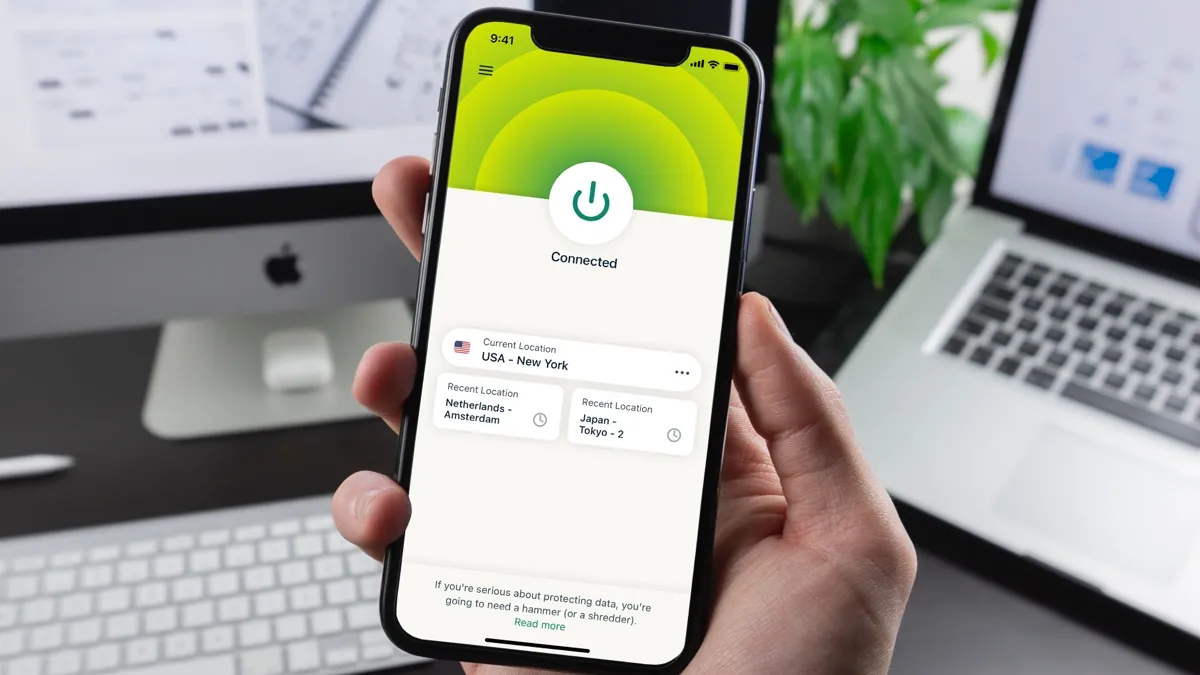
ExpressVPN’s mobile app offers slightly more information than its desktop counterpart, showing how much time you’ve spent connected and including a shortcut to switch protocols. A footer menu makes accessing the settings more straightforward than the desktop app.
Overall, Surfshark and ExpressVPN's apps are beginner-friendly. They’re not quite as slick as those of Proton VPN after its recent app overhaul, but they’re still among the best in class and won’t be causing any headaches.
Customer support
As easy to use as Surfshark and ExpressVPN are, it’s nice to be able to get help as and when you need it.
These are two VPN providers that provide 24/7 live chat and email support. Generally speaking, we received replies via live chat in a matter of minutes, whereas email takes anything from a few hours to a day.
Aside from live chat and email, Surfshark and ExpressVPN have handy help centers that are packed full of troubleshooting articles and step-by-step setup guides, many of which feature annotated screenshots so they’re even easier to follow. Both are extremely extensive, more so than most rivals.
Where Surfshark and ExpressVPN separate themselves from most VPNs, however, is in their video guides. Surfshark has the edge here, however, with a YouTube channel that’s a lot more active with videos posted far more recently. This includes updates on new features, troubleshooting, how-tos, discussion points, and more.
Verdict
Surfshark and ExpressVPN have a lot of similarities that put them among the best VPNs available. This includes global server networks, a strong set of security features, user-friendly apps, and 24/7 support. They’re not without their differences, however.
Of the two VPNs, Surfshark is faster, making it arguably more suitable for streaming, gaming, and torrenting. Unlike ExpressVPN, it has an unlimited simultaneous connection allowance, Double VPN (MultiHop servers), and includes an antivirus. It also does all this while offering more affordable one-month, one-year, and two-year subscription plans.
You may prefer ExpressVPN if you particularly want to bundle your VPN with a password manager, as that feature is unique to ExpressVPN, or want the added convenience of its custom router firmware. Overall, Surfshark edges this competition, but it’s easy to try both Surfshark and ExpressVPN risk-free because they come with 30-day money-back guarantees.

You must confirm your public display name before commenting
Please logout and then login again, you will then be prompted to enter your display name.